

Updated on March 2, 2026
As the list of states approving the use of marijuana continues to grow, one thing seems to come into play. “If it is legal, it must be safe to drive.” Not true. Driving while high on marijuana is against the law in all states.
If you are curious about the process the police use to determine if someone is under the influence of marijuana, the process is not as clear-cut as it is with alcohol. There is not a “per se” level of marijuana intoxication that automatically determines the person is too high to drive.
Let’s take a look at the process of an actual marijuana DUI.
What is Marijuana DUI?
A marijuana DUI is the act of driving a vehicle while the person driving is impaired by THC, the psychoactive component of marijuana.
In most states, driving a vehicle while under the influence of any drug, including marijuana, is considered a crime, and in a few states, there are specific restrictions on the level of THC in a person’s blood.
While marijuana is legal in a few states, driving under the influence of marijuana is a crime.
Why Marijuana DUI Testing Is More Complicated Than Alcohol
Alcohol impairment is relatively predictable. Breath tests measure Blood Alcohol Concentration (BAC), and 0.08% is the nationwide per se limit.
Marijuana is different because:
-
THC is fat-soluble, not water-soluble like alcohol.
-
It rapidly leaves the bloodstream and moves into body fat.
-
It can re-enter the bloodstream later.
-
Chronic users may test positive long after impairment ends.
-
Occasional users may be impaired at low measurable levels.
There is no scientific consensus that a specific THC number equals impairment in all drivers.
This scientific uncertainty is one reason marijuana DUI cases are often more complex in court.
How Police Investigate Marijuana DUI
When an officer suspects marijuana impairment, the investigation usually unfolds in stages.
1. Driving Behavior and Initial Observations
Officers first look for:
-
Swerving or lane drifting
-
Slow reaction time
-
Inconsistent speed
-
Failure to obey traffic signals
During the stop, they may note:
-
Odor of marijuana
-
Bloodshot or watery eyes
-
Slow speech
-
Delayed responses
-
Admission of recent use
These observations form the basis for further testing.
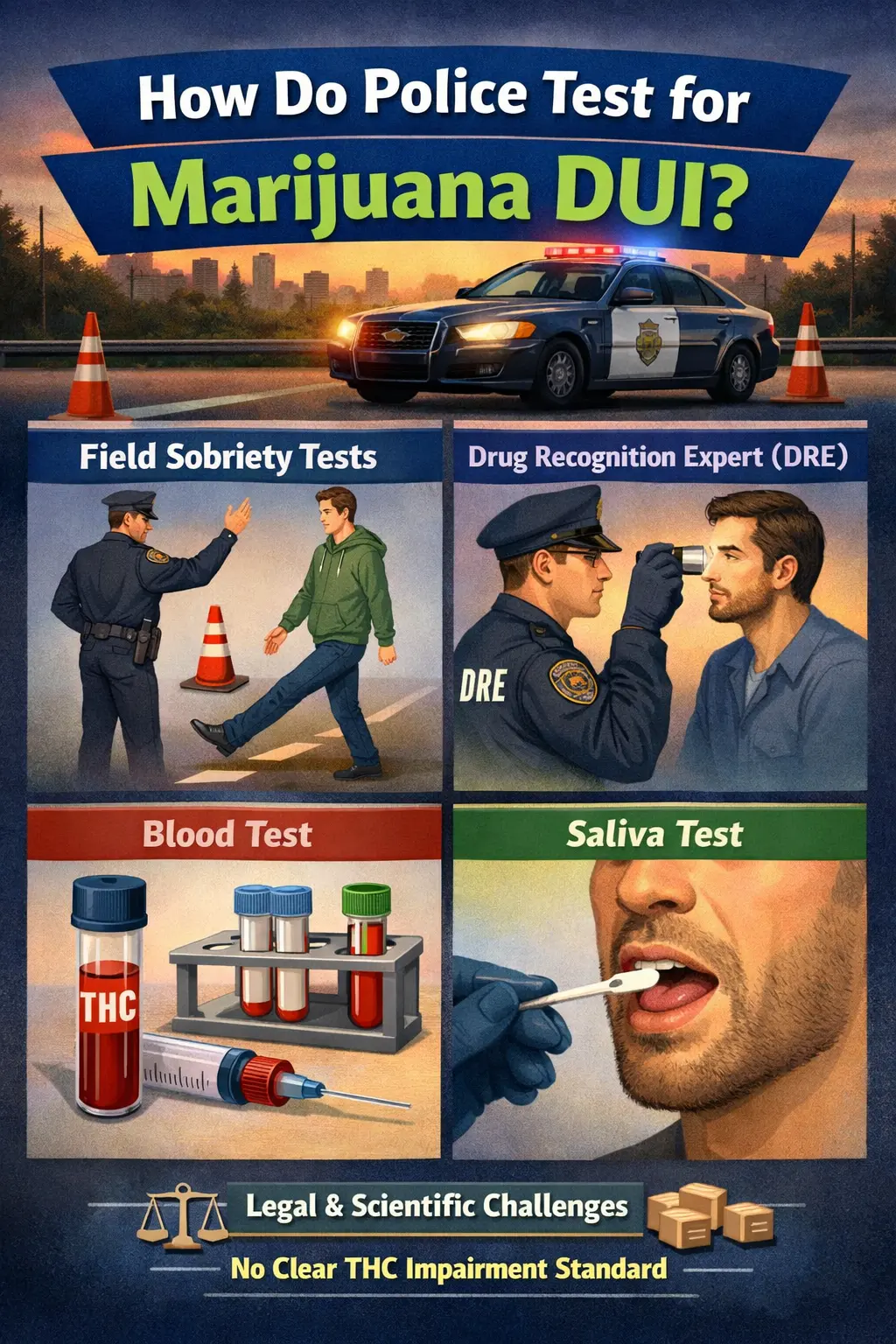
2. Field Sobriety Tests (FSTs)
Officers typically administer standardized field sobriety tests such as:
-
Walk-and-turn
-
One-leg stand
-
Horizontal gaze nystagmus (HGN)
However, marijuana affects coordination differently than alcohol. HGN, for example, is more reliable for alcohol than cannabis.
Field sobriety tests are subjective and frequently challenged in court.
3. Drug Recognition Expert (DRE) Evaluation
In many jurisdictions, a specially trained officer known as a Drug Recognition Expert conducts a more detailed evaluation.
The DRE program is overseen nationally by the International Association of Chiefs of Police.
A DRE performs a 12-step evaluation that includes:
-
Eye examinations
-
Vital signs (pulse, blood pressure, temperature)
-
Muscle tone assessment
-
Divided attention tasks
-
Dark room pupil testing
-
Toxicology request
The DRE forms an opinion about whether the driver is impaired and what category of drug may be involved.
This opinion is often used heavily by prosecutors in marijuana DUI cases.
Chemical Testing Methods
If probable cause is established, officers request a chemical test.
Under implied consent laws, refusing can result in license suspension.
Blood Tests
Blood testing is the most common method for marijuana DUI cases.
It measures active THC in nanograms per milliliter (ng/mL).
Some states have numerical thresholds:
-
Colorado: 5 ng/mL creates a “permissible inference” of impairment.
-
Washington: 5 ng/mL per se limit.
-
California: No specific THC limit; prosecutors must prove actual impairment.
However, THC levels do not consistently correlate with driving impairment. A regular user may exceed 5 ng/mL while sober.
Legal Issue: Blood Draw Warrants
The U.S. Supreme Court ruled in Missouri v. McNeely that police generally need a warrant for non-consensual blood draws unless exigent circumstances exist.
This ruling plays a major role in DUI litigation.
Urine Tests
Urine testing detects THC metabolites, not active THC.
Because metabolites can remain for days or weeks, urine tests cannot reliably prove current impairment. For that reason, urine testing is less commonly used today in marijuana-only DUI cases.
Saliva (Oral Fluid) Tests
Some states now use roadside oral fluid testing.
Saliva tests detect recent THC use, typically within several hours. However:
-
Accuracy varies
-
Environmental contamination can affect results
-
Legal admissibility differs by state
These tests are expanding but still evolving legally.
Marijuana Breathalyzers
Researchers are developing THC breath testing devices designed to detect very recent use.
While promising, marijuana breathalyzers are not yet widely deployed nationwide. Their courtroom reliability remains under evaluation.
Legal Consequences of a Marijuana DUI
Penalties vary by state but may include:
-
Fines ranging from hundreds to thousands of dollars
-
License suspension
-
DUI education programs
-
Probation
-
Jail time (especially for repeat offenses)
-
Permanent criminal record
In states where marijuana is legal, penalties for DUI are often similar to alcohol DUI penalties.
Medical Marijuana and DUI
Medical marijuana authorization does not protect a driver from DUI charges.
Even if use is lawful, driving while impaired remains illegal. In states with numeric THC thresholds, medical users may face increased risk due to baseline THC levels.
How Marijuana DUI Cases Are Challenged in Court
Defense strategies often focus on:
-
Lack of clear impairment evidence
-
Weak or improperly administered field sobriety tests
-
Improper DRE procedures
-
Delays between driving and blood draw
-
Rising blood THC levels
-
Lack of correlation between THC level and impairment
-
Warrant violations under McNeely
Because there is no universally accepted THC impairment standard, these cases frequently involve scientific testimony.
How to Avoid a Marijuana DUI
The safest approach is simple:
-
Do not drive after consuming marijuana.
-
Allow sufficient time for effects to fully dissipate.
-
Understand that edibles last significantly longer than smoking.
-
Never combine marijuana with alcohol.
Legal marijuana does not mean legal driving while impaired.
FAQs
Can you refuse a marijuana DUI test?
Yes, but most states have implied consent laws. Refusal often triggers automatic license suspension and may be used as evidence in court.
How long does THC stay in your system?
Active THC may remain in blood for hours, but metabolites can remain for days or weeks. Detection does not always equal impairment.
Is there a nationwide legal THC limit?
No. Unlike alcohol’s 0.08% BAC standard, there is no national THC limit. Each state sets its own rules.
Are marijuana DUI penalties the same as alcohol DUI?
In many states, yes. First-time marijuana DUI offenses often carry penalties similar to alcohol DUI convictions.
Are marijuana breathalyzers currently used?
They are in development but not widely implemented nationwide.
Final Thoughts
Marijuana DUI laws are always evolving with the process of legalizing marijuana. Law enforcement uses what officers see, sobriety tests, Drug Recognition Experts, and chemical tests to assemble the puzzle.
Marijuana works uniquely from liquor and has not been demonstrated to have a general level of impairment, making these cases regularly complicated from a legal and scientific point of view.
Understanding how police test for marijuana DUI can help individuals make educated decisions and avoid legal trouble.

Avvo | Website | Yelp
