

Content Last Updated: February 17, 2026
Penalties, DMV Hearings, IID Options, and Long-Term Consequences
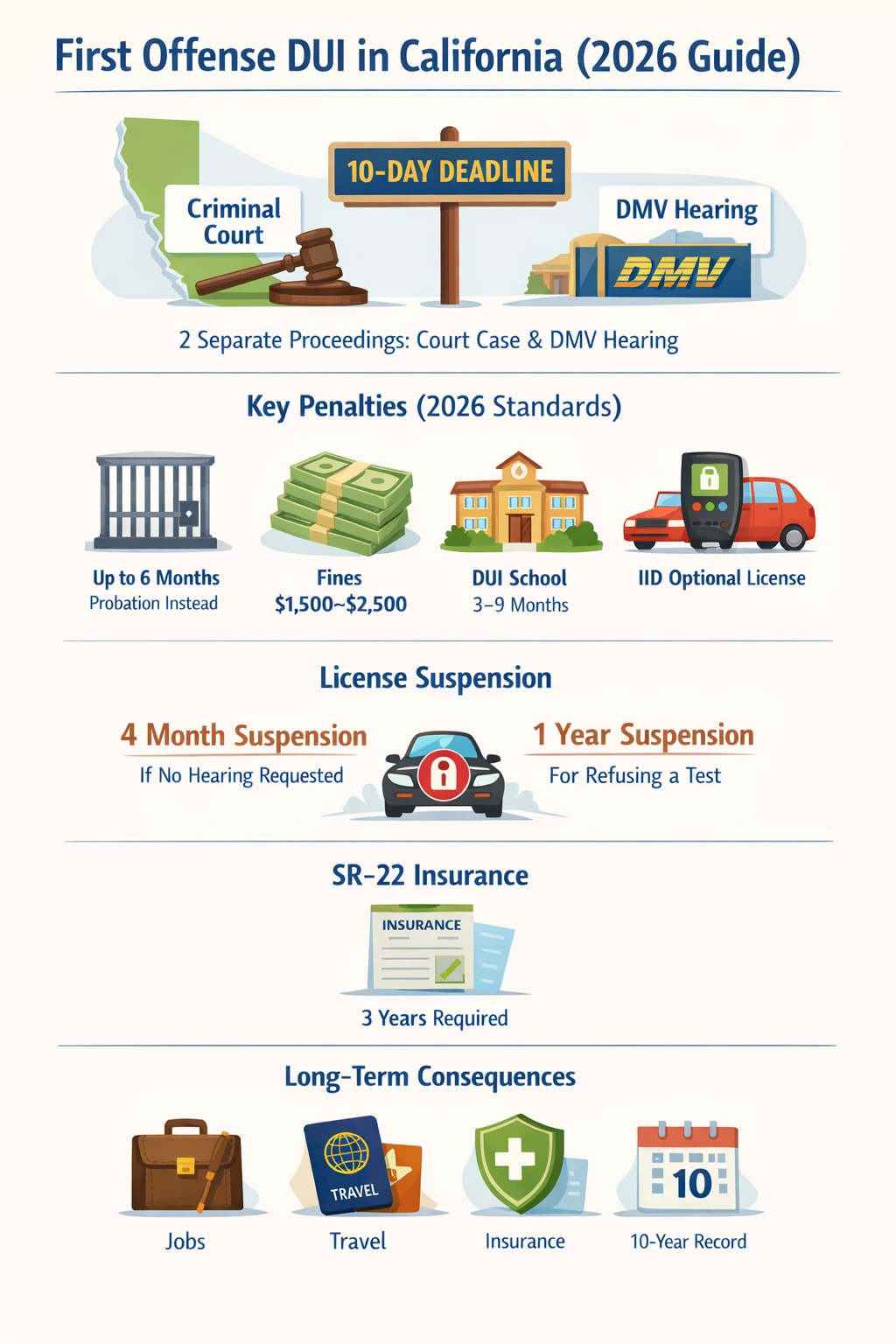
A first-time DUI arrest in California triggers two completely separate legal proceedings:
-
A criminal court case
-
A DMV Administrative Per Se (APS) action
Many people focus only on court — and lose their license because they ignored the DMV deadline. This guide explains both systems step-by-step using current 2026 standards.
Step 1: The 10-Day Rule (Critical Deadline)
After arrest, the officer typically:
-
Confiscates your driver’s license
-
Issues a temporary license (valid for 30 days)
You have 10 days from the date of arrest to request a DMV Administrative Per Se (APS) hearing.
If you do NOT request a hearing within 10 days:
-
Your license is automatically suspended
-
Suspension begins 30 days after arrest
-
Standard first offense suspension: 4 months
Requesting the hearing:
-
Stops (“stays”) the automatic suspension
-
Allows you to keep driving temporarily
-
Preserves your right to challenge the DMV case
Missing this deadline permanently forfeits your right to contest the administrative suspension.
The Two-Path System: Court vs. DMV
California DUI cases operate on parallel tracks.
1. The Criminal Court Case
Filed under California Vehicle Code 23152.
The court decides:
-
Guilt or innocence
-
Fines
-
Probation
-
Jail exposure
-
DUI school requirements
2. The DMV Administrative Case
Filed under California Vehicle Code 13353 (APS law).
The DMV only considers:
-
Whether you were driving
-
Whether your BAC was 0.08% or higher
-
Whether you refused chemical testing
-
Whether the arrest was lawful
Important Reality
You can:
-
Win in court but still lose your license at DMV
-
Lose in court but win your DMV hearing
They are legally independent proceedings.
Criminal Penalties (Standard First Offense – 2026)
For a typical misdemeanor DUI with no injuries:
Jail Time
-
Up to 6 months maximum exposure
-
Jail is often waived in standard first offenses
-
Most defendants receive probation instead
Fines
-
Base fine: $390–$1,000
-
With penalty assessments and court costs:
$1,500–$2,500 total
Probation
-
Typically 3 years of informal (summary) probation
-
Courts are increasingly imposing 5 years in cases involving aggravating factors
Probation conditions typically include:
-
Obey all laws
-
No driving with measurable alcohol
-
Submit to chemical testing if arrested again
DUI School (AB 541 Program)
Program length depends on BAC:
-
3 months (30 hours) if BAC below 0.15%
-
9 months if BAC 0.20% or higher
Completion is mandatory for license reinstatement.
Aggravating Factors That Increase Penalties
Certain factors make penalties more severe:
-
BAC 0.15% or higher
-
BAC 0.20% or higher
-
20+ mph over speed limit
-
Minor under 14 in vehicle
-
Accident involvement
-
Chemical test refusal
Aggravating factors often result in:
-
Longer DUI school
-
Stricter probation
-
Increased fines
-
Possible jail time
DMV Administrative Actions (APS)
Standard First Offense
If you:
-
Request hearing and lose → 4-month suspension
-
Do not request hearing → 4-month automatic suspension
Chemical Test Refusal
If you refused breath or blood testing after arrest:
-
1-year suspension
-
No restricted license option
-
No IID alternative
-
No early reinstatement
Refusal penalties are administrative and apply even if your criminal case is reduced.
Restricted License Options (First Offense – 2026)
Most first-time offenders can choose between two options:
Option 1: IID Restricted License
-
No 30-day waiting period
-
Immediate driving allowed
-
Must install Ignition Interlock Device (IID)
-
Must file SR-22 insurance
-
May drive anywhere, anytime (with IID)
2026 Update
The California Statewide IID program is extended through January 1, 2033.
IID Cost Categories
While costs vary, expect:
-
Installation fee
-
Monthly monitoring fee
-
Required calibrations
-
Removal fee
Option 2: Work/Program Restricted License
-
Requires 30-day “hard” suspension first
-
Driving limited to:
-
Work
-
DUI school
-
Court-ordered programs
-
-
No general driving privileges
SR-22 Insurance Requirement
After a DUI-related suspension, you must file an SR-22 certificate.
Key facts:
-
Required for 3 years
-
Must be continuous
-
Any lapse triggers new suspension
-
Insurance premiums significantly increase
SR-22 is mandatory to reinstate or maintain driving privileges.
Timeline: What Happens After Arrest
Day 0 – Arrest and temporary license issued
Day 1–10 – Deadline to request DMV hearing
Day 30 – Suspension begins if no hearing requested
30–90 Days – Arraignment and court proceedings
Post-Conviction – DUI school enrollment
During Suspension – IID or restricted license process
Up to 3 Years – SR-22 requirement
Up to 10 Years – Offense remains priorable
What If Charges Are Reduced?
Wet Reckless
-
Reduced alcohol-related offense
-
Still priorable for 10 years
-
Usually shorter DUI school
-
DMV consequences may still apply
Dry Reckless
-
Non-alcohol-related reduction
-
Not priorable as DUI
-
DMV suspension may still stand unless APS won
Important: A reduction in court does NOT automatically reverse DMV suspension.
Long-Term Consequences
10-Year Priorability
A first DUI is priorable for 10 years (arrest-to-arrest).
If re-arrested within 10 years:
-
Treated as second offense
-
Penalties significantly increase
Employment Impact
-
Background checks
-
Professional licensing
-
Security clearances
Immigration Considerations
-
Multiple DUIs can create immigration complications
Travel Restrictions
-
Canada may deny entry based on DUI history
-
DUI typically disqualifies drivers from major platforms
Probation Violations
Violating DUI probation (new arrest, alcohol violation, missed classes) may result in:
-
Additional fines
-
Jail time
-
Probation extension
-
Bench warrant
License Reinstatement Checklist
To reinstate driving privileges:
-
Complete required suspension period
-
Enroll or complete DUI school
-
File SR-22
-
Install IID (if required)
-
Pay reinstatement fees
All requirements must be satisfied simultaneously.
Common Myths
Myth: First DUIs always mean jail.
Reality: Jail is often waived in standard first offenses.
Myth: Winning in court restores your license.
Reality: DMV action is separate.
Myth: Refusing the test avoids suspension.
Reality: Refusal triggers a 1-year suspension with no restriction.
Myth: A DUI disappears quickly.
Reality: It remains priorable for 10 years.
Frequently Asked Questions
Do I lose my license immediately after arrest?
No. You have 10 days to request a DMV hearing before automatic suspension begins.
Can I drive right away after a DUI?
Yes, temporarily. After that, you must request a hearing or choose a restricted option.
Is a first DUI a felony?
No, it is typically a misdemeanor unless injuries are involved.
Can I expunge a first DUI?
In many cases, yes — after probation is completed — but expungement does not erase DMV record or priorability.
How long does a first DUI stay on my record?
It is priorable for 10 years for sentencing purposes.
Final Takeaways (2026)
-
The 10-day DMV deadline is critical.
-
Court and DMV are separate systems.
-
Most first offenses involve probation, fines, and DUI school — not jail.
-
IID licenses allow immediate driving.
-
Refusal leads to 1-year suspension with no restriction.
-
SR-22 insurance is required for 3 years.
-
A DUI remains priorable for 10 years.
A first DUI in California is serious — but procedural mistakes, especially missing the DMV deadline, often cause more damage than the charge itself. Understanding both systems is the key to protecting your driving privileges and minimizing long-term impact.

Avvo | Website | Yelp