


Last Updated: March 2026
Remember, Aggravated DUIs are very serious offenses.
| Category | Information |
|---|---|
| Definition | Aggravated DUI (driving under the influence) is a more serious version of standard DUI charges in California. Aggravated DUI occurs when certain factors, known as "aggravating factors," are present in the case that enhances the seriousness of the offense. |
| Aggravating Factors | These may include: repeat offenses, high blood alcohol content (BAC) (typically .15% or higher), DUI with minor in the car, DUI causing injury or death, DUI with suspended or revoked license, speeding or reckless driving during the DUI, and refusal to take a chemical test. |
| Legal Code | Vehicle Code 23578 VC (enhancement for high BAC), Vehicle Code 23572 VC (enhancement for minor in vehicle), Vehicle Code 23550 VC (enhancement for repeat offenses), Penal Code 191.5(b) PC (vehicular manslaughter while intoxicated). |
| Penalty | This varies depending on the specifics of the case and the defendant's prior convictions. However, the consequences may include: longer jail or prison sentences, higher fines, longer DUI school, longer license suspension, installation of an ignition interlock device (IID), designation as a "habitual traffic offender" (HTO), and potentially even a strike under California's Three Strikes Law. |
| Ignition Interlock Device (IID) Requirement | Typically, for repeat offenses or when the BAC is significantly high, the court might require the installation of an IID in the offender's vehicle. The IID prevents the vehicle from starting if it detects alcohol on the driver's breath. |
| DUI School | Often, those convicted of aggravated DUI are required to complete a DUI education program. These programs can range from 9 months to 30 months long, depending on the severity of the offense and the defendant's prior convictions. |
| Probation | A judge may order probation in lieu of, or in addition to, jail or prison time for an aggravated DUI conviction. Probation terms typically include mandatory DUI school attendance, regular drug/alcohol testing, and refraining from committing any more crimes. |
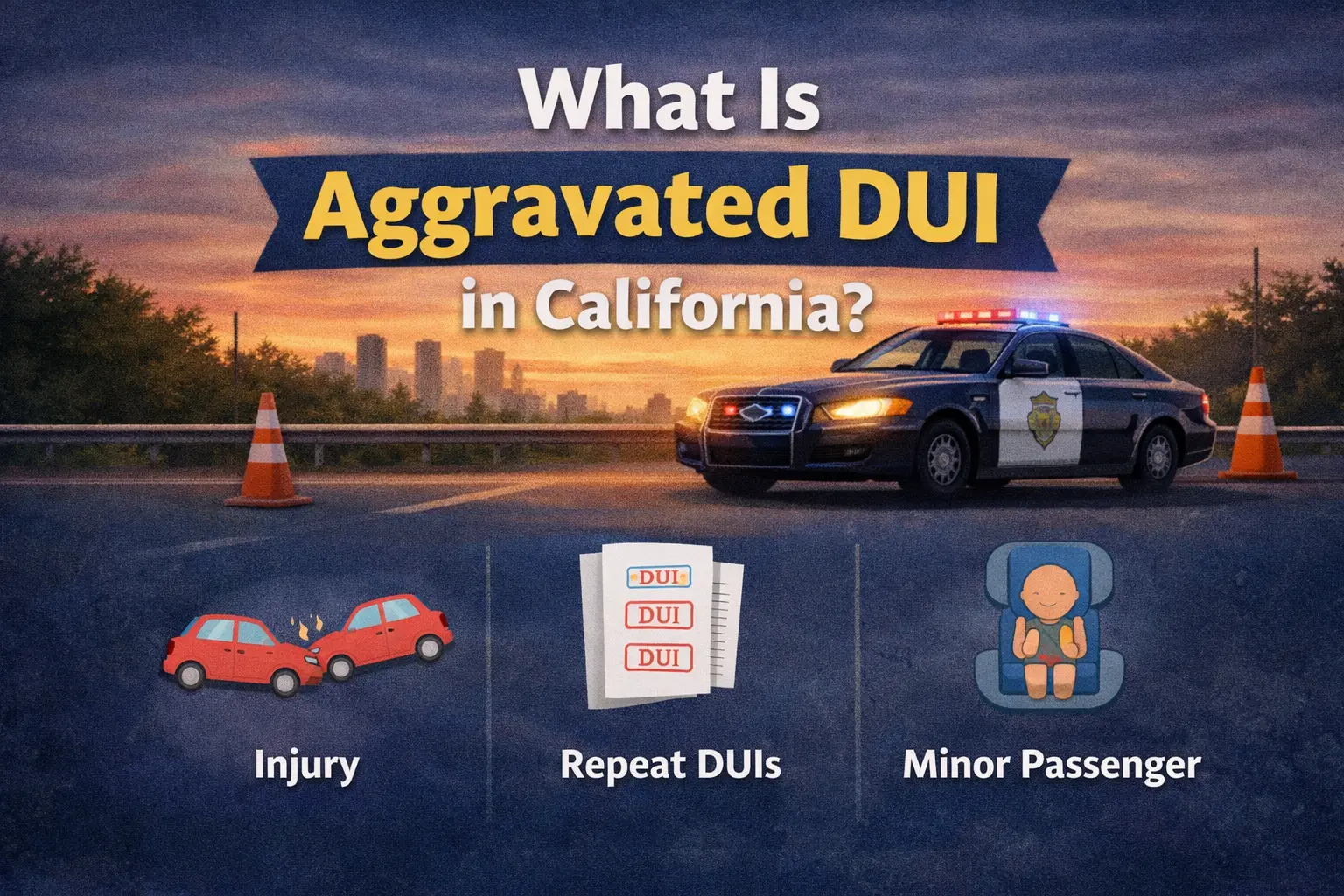
What Is Aggravated DUI in California?
If you were arrested for DUI in California and someone mentioned the term “aggravated DUI,” you’re probably wondering how serious your situation is.
Here’s the truth: in California, there is no single law called “Aggravated DUI.” You won’t find that phrase printed in the Vehicle Code. What people mean by “aggravated DUI” is a DUI case involving special circumstances that dramatically increase the penalties — and sometimes turn the charge into a felony.
In real courtrooms across California, these cases are handled very differently than a standard first-time misdemeanor DUI. Judges treat them more seriously. Prosecutors push harder. And the long-term consequences can be life-changing.
This article explains exactly how aggravated DUI works under California law, what statutes apply, how sentencing enhancements are added, and what defenses may be available.
DUI Law in California
A basic DUI in California is charged under Vehicle Code § 23152. It typically involves:
-
Driving under the influence of alcohol or drugs, or
-
Driving with a blood alcohol concentration (BAC) of 0.08% or higher
But when certain aggravating factors are present, prosecutors rely on other sections of the Vehicle Code to increase punishment.
The three most important statutes in aggravated DUI situations are:
-
California Vehicle Code § 23153
-
California Vehicle Code § 23550
-
California Vehicle Code § 23572
Each applies in different circumstances.
DUI Causing Injury – Vehicle Code § 23153
What Prosecutors Must Prove
Under California Vehicle Code § 23153, a person commits DUI causing injury when:
-
They drive under the influence of alcohol and/or drugs,
-
They also commit an unlawful act (such as speeding or unsafe lane change) or neglect a legal duty, and
-
That unlawful act causes bodily injury to another person.
The injury must be to someone other than the driver.
Misdemeanor or Felony?
Section 23153 is a “wobbler,” meaning it can be charged as either:
-
A misdemeanor, or
-
A felony
The decision depends on factors such as:
-
Severity of injury
-
Defendant’s prior record
-
Number of victims
-
BAC level
Sentencing Range (Felony Filing)
If charged as a felony, penalties may include:
-
16 months, 2 years, or 3 years in state prison
-
One additional consecutive year per additional injured victim (up to 3 victims)
-
Fines up to $5,000
-
Formal probation
-
Restitution to victims
Great Bodily Injury Enhancement
If the prosecution alleges “great bodily injury” under Penal Code § 12022.7, an additional 3 years may be added to the prison term.
This enhancement significantly increases exposure.
Fourth DUI or Prior Felony DUI – Vehicle Code § 23550
Under California Vehicle Code § 23550, a DUI becomes a felony if:
-
The defendant has three or more prior DUI convictions within 10 years, or
-
The defendant has a prior felony DUI conviction.
The 10-Year Lookback Rule
California uses a 10-year “lookback period.” The clock starts from the date of violation to the date of the new violation — not conviction dates.
Qualifying prior offenses include:
-
DUI under VC 23152
-
DUI causing injury under VC 23153
-
Wet reckless (VC 23103.5)
Felony DUI Sentencing
Penalties may include:
-
16 months, 2 years, or 3 years in state prison
-
Up to $5,000 in fines
-
4-year driver’s license revocation
-
Designation as a Habitual Traffic Offender
-
18- or 30-month DUI program
A felony DUI also results in a permanent felony conviction unless later reduced under limited circumstances.
DUI With a Minor Passenger – Vehicle Code § 23572
Under California Vehicle Code § 23572, additional jail time is mandatory if a child under 14 years old was a passenger during the DUI.
This is not a separate crime. It is a sentencing enhancement added to the base DUI sentence.
Mandatory Additional Jail Time
-
First DUI: 48 additional hours
-
Second DUI: 10 additional days
-
Third DUI: 30 additional days
-
Fourth DUI: 90 additional days
Judges have limited discretion to waive this enhancement.
In some cases, prosecutors may also file child endangerment charges under Penal Code § 273a, which is a separate offense.
High BAC as an Aggravating Factor
California does not have a separate “Super Extreme DUI” law. However, high BAC levels are considered aggravating circumstances.
If your BAC was:
-
0.15% or higher
-
0.20% or higher
The court may impose:
-
Longer DUI education programs
-
Higher fines
-
Stricter probation terms
Judges often view extremely high BAC levels as evidence of significant impairment.
Sentencing Enhancements vs Felony Filing
It is important to understand the difference.
Felony Filing
Certain factors elevate the charge itself:
-
DUI causing injury (§23153)
-
Fourth DUI within 10 years (§23550)
These expose the defendant to state prison.
Sentencing Enhancements
Other factors increase punishment but do not change the base charge:
-
Minor in vehicle (§23572)
-
High BAC
-
Refusal to submit to chemical testing
-
Excessive speed
Enhancements are added to the underlying DUI sentence.
Defending an Aggravated DUI in California
These cases are more complex and require a detailed review of evidence.
Common defense approaches include:
Challenging the Stop
If the officer lacked reasonable suspicion, the stop may violate the Fourth Amendment. Evidence obtained afterward could potentially be suppressed.
Attacking Chemical Test Accuracy
Breath and blood tests are not infallible. Potential issues include:
-
Improper calibration
-
Faulty breath machines
-
Improper blood storage
-
Fermentation of samples
-
Chain-of-custody errors
In some cases, rising blood alcohol levels may mean the driver was below 0.08% while driving but above it when tested.
Disputing Causation in Injury Cases
In §23153 cases, prosecutors must prove your conduct caused the injury.
If another driver ran a red light, or if road conditions caused the crash, causation may be contested.
Challenging Prior Convictions
Under §23550, prior convictions must fall within the 10-year “lookback period.” If a prior conviction is outside the window or improperly documented, the felony filing may not stand.
Fighting Enhancements
Enhancements like §23572 must be proven. If the prosecution cannot establish the child’s age or presence beyond a reasonable doubt, the enhancement may not apply.
Long-Term Consequences of an Aggravated DUI
Beyond jail or prison, consequences may include:
-
Years of increased insurance premiums
-
Employment difficulties
-
Professional license issues
-
Immigration consequences
-
Habitual traffic offender designation
-
Permanent felony record (if convicted of a felony DUI)
Felony DUI convictions can affect housing applications, firearm rights, and background checks.
Key Takeaways for California Drivers
-
“Aggravated DUI” is not a standalone law in California.
-
DUI causing injury falls under §23153.
-
Repeat felony DUI is governed by §23550.
-
Minor passenger enhancements are under §23572.
-
Some factors elevate the charge to a felony. Others increase sentencing only.
Understanding how these statutes apply to your situation is critical because the penalties can be severe.
Frequently Asked Questions
What does “aggravated DUI” legally mean in California?
California does not have a statute specifically titled “aggravated DUI.” The term is commonly used to describe DUI cases involving circumstances that increase penalties or elevate the charge to a felony. These typically involve DUI causing injury under California Vehicle Code § 23153, repeat felony DUI under California Vehicle Code § 23550, or sentencing enhancements such as a minor passenger under California Vehicle Code § 23572.
Is aggravated DUI automatically a felony?
Not always.
A DUI becomes a felony if:
-
It involves injury to another person (§23153), or
-
It is a fourth DUI within 10 years (§23550), or
-
The driver has a prior felony DUI conviction.
Other aggravating factors — like high BAC or a minor in the vehicle — increase penalties but do not automatically make the case a felony.
How many DUIs make it a felony in California?
A fourth DUI within 10 years can be charged as a felony under §23550. The 10-year period is measured from violation date to violation date, not conviction date.
What qualifies as “injury” in a DUI causing injury case?
Under §23153, prosecutors must prove that the DUI driver committed an unlawful act (like speeding or unsafe turning) that caused bodily injury to another person.
“Injury” can range from minor physical harm to serious bodily injury. If the injury qualifies as “great bodily injury,” additional prison time may apply under Penal Code §12022.7.
Does a high BAC make my DUI aggravated?
A high BAC (0.15% or above) does not create a separate crime, but it is considered a sentencing factor under California Vehicle Code § 23578. Judges may impose longer DUI programs and stricter probation conditions.
What happens if I refuse a breath or blood test?
Refusal can trigger enhanced penalties under California law, including:
-
Longer license suspension
-
Additional mandatory jail time
-
Court-imposed penalties beyond the base DUI
Refusal does not automatically make the charge a felony, but it can significantly increase consequences.
Does having a child in the car make it a felony?
No, not automatically.
Under §23572, having a child under 14 in the vehicle adds mandatory jail time to the DUI sentence. However, the underlying DUI remains a misdemeanor unless other felony factors apply.
In some cases, prosecutors may also file separate child endangerment charges.
Can aggravated DUI charges be reduced?
In some cases, yes.
Possible outcomes may include:
-
Reduction from felony to misdemeanor
-
Negotiated plea to a lesser offense
-
Dismissal of enhancements
-
Suppression of evidence due to constitutional violations
The facts of the case, prior record, and strength of the prosecution’s evidence all matter.
Will I go to prison for an aggravated DUI?
Prison is possible if the case is filed as a felony — particularly for:
-
DUI causing injury
-
Fourth DUI within 10 years
-
DUI involving great bodily injury
However, not every felony DUI results in prison. Some cases resolve with probation depending on the circumstances.
How long will my license be suspended?
License consequences vary based on:
-
Number of prior offenses
-
Whether the case is misdemeanor or felony
-
Whether there was a chemical test refusal
Felony DUI convictions may result in multi-year revocation. Administrative suspension through the DMV is separate from court penalties.
Does aggravated DUI affect employment?
Yes.
A felony DUI conviction can:
-
Appear on background checks
-
Impact professional licenses
-
Affect commercial driving privileges
-
Increase insurance premiums
Misdemeanor aggravated factors may still have serious employment consequences.
Is aggravated DUI handled in state or federal court?
Almost all DUI cases in California are handled in California Superior Court under state law. Federal jurisdiction typically applies only if the offense occurred on federal property.
What should I do after being charged?
If you are facing an aggravated DUI charge:
-
Do not discuss your case publicly
-
Request a DMV hearing within 10 days if your license was taken
-
Review the evidence carefully before making decisions
Because aggravated DUI cases carry enhanced penalties, early legal strategy often makes a significant difference.